

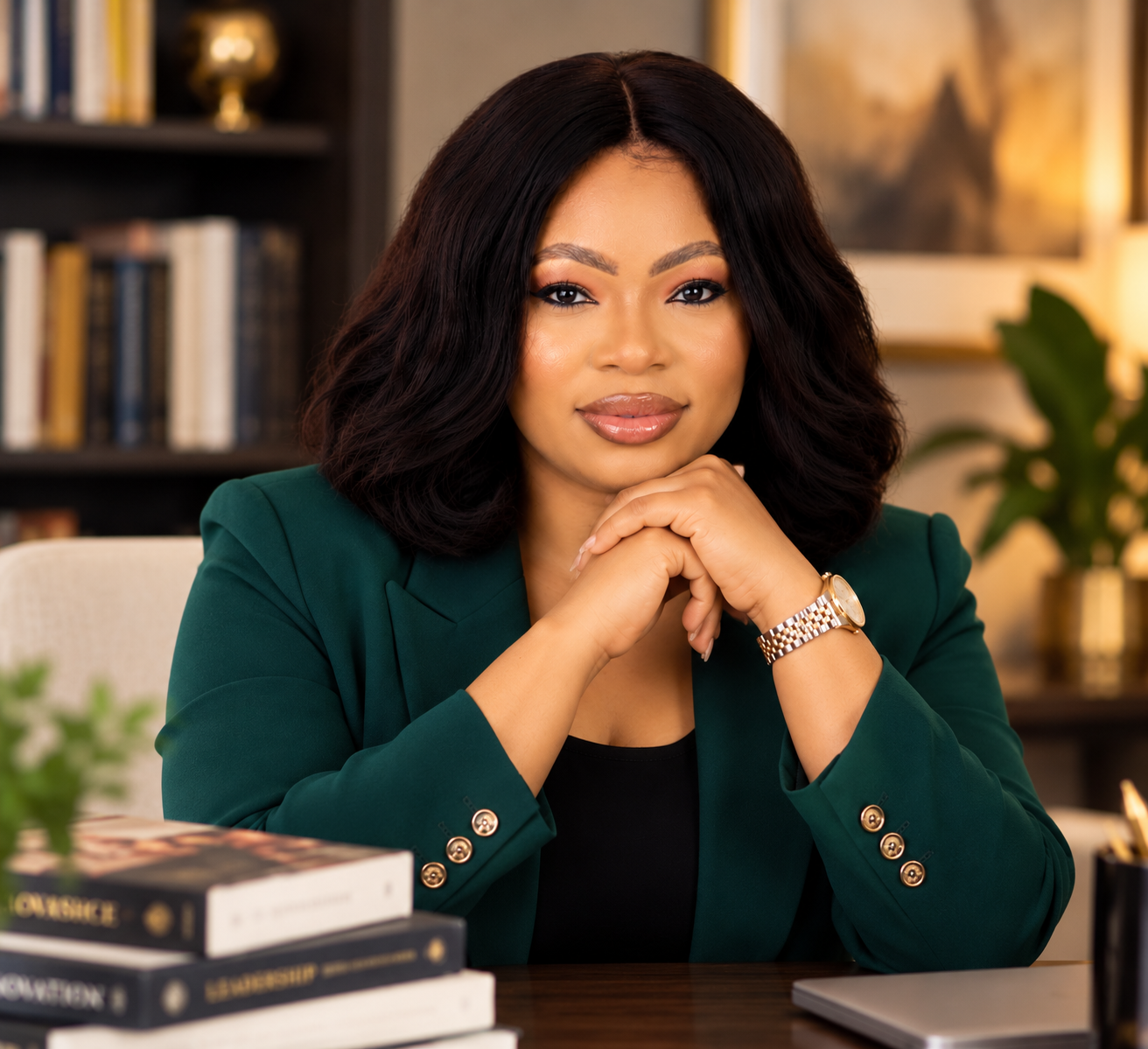
Today we talk about Birth of a Fractured Nation, a book by Kemi Ayanda published with our Publishing house Europe Books.
Europe Books had the pleasure of interviewing the author, Kemi Ayanda, to get to know her better, what prompted her to the writing of her book Birth of a Fractured Nation, as well as how she chose the title of her book.
Below you can find our interview. Take a seat and enjoy your reading!!!
- What prompted to the writing of your book?
I have always been fascinated by a fundamental contradiction: how can nations so richly endowed with human potential, natural resources and extraordinary resilience remain trapped in cycles of dysfunction, inequality and unfulfilled promise? Birth of a Fractured Nation emerged from that question, but also from something more personal: a refusal to accept that the stories of nations should be told only through statistics, political commentary or historical accounts. Behind every failed institution, contested election, broken promise or courageous act of resistance are human beings whose lives are profoundly affected by decisions made in corridors of power. I wanted to explore those lives through fiction. The novel asks what happens when ordinary people begin to challenge an extraordinary concentration of power. Through characters such as Emeka and Aisha, it examines the courage required to confront injustice, the compromises that accompany political ambition and the difficult relationship between idealism and reality. Ultimately, I was compelled to write a story that goes beyond exposing what is broken. It asks whether a fractured nation can truly be rebuilt, who gets to shape its future and what transformation demands of those brave enough to pursue it.
- What of your life experiences inspired you to write your story?
My experiences growing up in Nigeria, combined with years of working across development, governance, institutional transformation and economic policy, have profoundly shaped how I understand the relationship between power and people’s everyday lives. I have encountered remarkable individuals working tirelessly to create change, often within systems that seem almost designed to resist it. I have also observed how good intentions can become entangled in institutional weaknesses, competing interests and political realities. These experiences have taught me that the distance between what a nation promises and what its citizens experience can be enormous. But what has stayed with me most is the human dimension: the resilience of communities, the quiet sacrifices of families, the courage of those who speak out and the complicated choices people make when survival, loyalty and principle collide. These experiences informed the emotional and political landscape of Birth of a Fractured Nation, although the characters and events are fictional. I wanted to capture something that professional reports and policy discussions rarely convey fully: what it feels like to live inside a society struggling with its own contradictions, and what it takes to imagine a different future.
- What would you like to hear from your readers?
More than anything, I would love to know which questions remain with readers long after they turn the final page. Did they recognise something of their own society in the world of the novel? Did they find themselves sympathising with a character whose decisions they initially condemned? Did the story challenge what they believed about leadership, loyalty, justice or the possibility of meaningful change? I would be particularly interested in hearing how readers interpret Emeka and Aisha’s journeys, because their experiences raise questions that extend far beyond the fictional nation they inhabit. What happens when those who challenge power are eventually confronted with the prospect of exercising it? Can individuals remain faithful to their convictions when the cost of doing so becomes deeply personal? I also hope readers will tell me about the moments that moved, unsettled or surprised them. I do not expect everyone to agree with the choices my characters make. In fact, I would be delighted if the novel provoked spirited conversations and competing interpretations. For me, the greatest compliment would be hearing that readers finished the book entertained, emotionally invested and perhaps seeing the world a little differently.
- How did you choose the title of your book?
The title Birth of a Fractured Nation is deliberately paradoxical. Birth ordinarily suggests hope, possibility and new beginnings. Fracture evokes division, conflict and something fundamentally broken. Bringing these ideas together captures the central tension of the novel: how can a nation be born into promise yet inherit the very contradictions that threaten its future? I wanted a title that would provoke curiosity before readers encountered the first character. What gives birth to a nation? Is it a declaration of independence, a shared identity, a political settlement or the collective determination of its people? And what happens when the foundations upon which that nation is built are already divided? The title also reflects my belief that national fractures are rarely sudden. They develop through accumulated choices, historical grievances, institutional failures and the persistent struggle over who belongs, who benefits and who holds power. Importantly, the word “birth” also carries the possibility of renewal. Even amid profound division, something new can emerge. As the opening novel in the Child of Many Fathers series, the title establishes the central question that runs throughout the saga: who truly shapes a nation’s destiny?
- Are you working on a new writing project you can tell us about?
Absolutely! In fact, Birth of a Fractured Nation is only the beginning of a much larger literary journey. It opens Child of Many Fathers, an ambitious six-book political fiction series that I have completed. While the first novel introduces readers to a society confronting deep political and institutional fractures, the subsequent books expand the story into an increasingly intricate struggle over power, influence, loyalty and the future of a nation. The narrative moves beyond the excitement of resistance to explore an even more challenging question: what happens after those demanding change begin to acquire power themselves? Readers will encounter shifting alliances, formidable political interests, unexpected betrayals, difficult moral choices and characters whose convictions are tested in ways they never anticipated. What excites me most is the opportunity to explore political transformation across multiple generations and perspectives, revealing how the decisions of a few can shape the destinies of millions. Although inspired by African political realities, the series addresses universal questions about democracy, identity, leadership and human ambition. My hope is that readers who enter this world through Birth of a Fractured Nation will discover that its deepest conflicts are only beginning.
Europe Books thanks the author, Kemi Ayanda, once again for taking the time and answering our questions. We are really pleased to have walked alongside her on the editorial path that led to the publication of her book Birth of a Fractured Nation. We wish her the best of luck for her future works.
To you, my readers, may this book move you and serve as a source of inspiration, through the trials the main characters face and the choices they make; may it, in some way, prompt you to reflect on how you might improve your own life.
So, my dear readers, all I have to say is to enjoy your reading!
Your Editor!